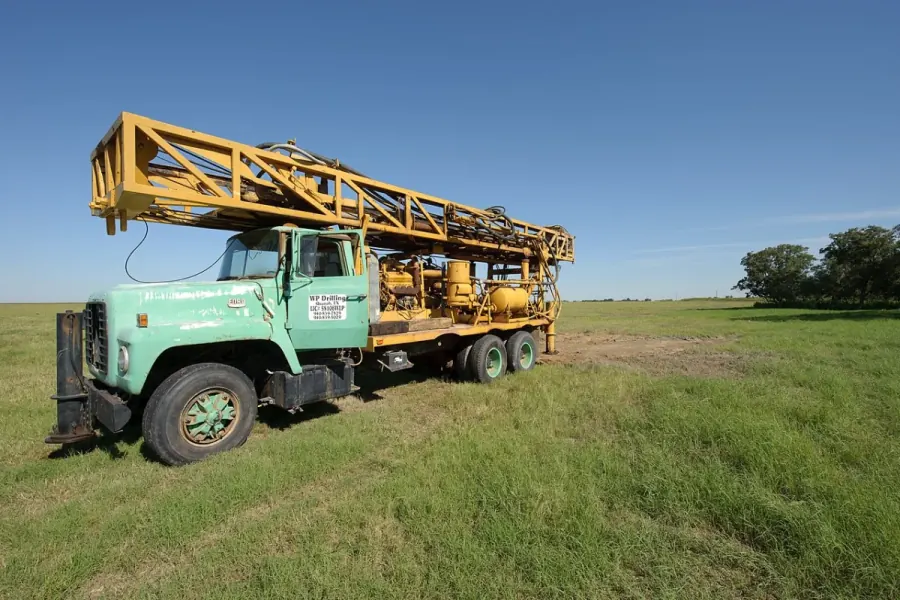
Water well drilling in El Paso costs $28 to $64 per foot, and at the county median depth a complete residential system runs about $10,800 to $18,000. That buys the borehole, casing, screen, filter pack, annular seal, development, yield testing, pump, pressure tank, electrical, a water sample and the filed State of Texas Well Report. Drilling and casing on their own at the same depth are closer to $4,500 to $11,700.
El Paso is an unusual Texas market in two ways that both work in a well owner's favor. There is no groundwater conservation district in the county, so there is no district permit, no spacing rule and no production cap on a domestic well. And local wells are shallower than the published advice suggests, which means the total project cost here is often lower than in parts of Texas with a cheaper per-foot rate.
What water well drilling costs in El Paso, TX
Cost scales with depth almost linearly, because rig time, casing footage and grout volume all scale with it. The table below applies the local $28 to $64 per foot range across the depths El Paso County wells actually reach.
| Completed depth | Drilling and casing | Complete system |
|---|---|---|
| 100 ft | $2,800 to $6,400 | $7,600 to $11,200 |
| 150 ft | $4,200 to $9,600 | $9,400 to $14,800 |
| 200 ft | $5,600 to $12,800 | $11,200 to $18,400 |
| 300 ft | $8,400 to $19,200 | $14,800 to $25,600 |
| 400 ft | $11,200 to $25,600 | $18,400 to $32,800 |
| 500 ft | $14,000 to $32,000 | $22,000 to $40,000 |
Complete system adds pump, pressure tank, electrical, permits and reporting, and water testing to the drilling figure. Texas statewide averages about $8,550 at $25 to $58 per foot, so El Paso sits above the state per foot and frequently below it on total project cost because our wells are shallower.
The reason a per-foot rate matters more than a headline total: two bids can carry the same number and describe completely different wells. Ask for the assumed depth, the per-foot rate, the casing diameter and material, and the mechanism if the hole runs deeper than planned. A bid without those four items is an opinion.
How deep wells actually go in El Paso County
The median completed depth in El Paso County is 160 feet, and 180 feet for wells drilled since 2016. Those figures come from 517 State of Texas Well Reports filed with the Texas Department of Licensing and Regulation, which is the only complete record of legal wells in the county. The usual range is 80 to 570 feet.
| Depth band | Wells | Typical setting |
|---|---|---|
| 0 to 50 ft | 18 | Shallow valley alluvium and older hand-dug wells |
| 50 to 100 ft | 134 | Rio Grande valley alluvium, the commonest band |
| 100 to 150 ft | 88 | Valley margin and terrace properties |
| 150 to 200 ft | 32 | Transition between valley and mesa |
| 200 to 300 ft | 47 | Mesa edge, upper bolson fill |
| 300 to 400 ft | 18 | Bolson fill |
| 400 to 600 ft | 55 | Deeper bolson, east and far west mesa |
| 600 ft and deeper | 124 | Deep bolson production wells |
Median static water level across the same records is 15 feet below surface, with the middle half of records spanning 9 to 175 feet. Well density is highest in ZIP codes 79922 (95 reports) and 79932 (83), both on the Rio Grande corridor on the west side.
Valley wells and mesa wells are different jobs
The depth distribution above has two humps, and the landform explains both. El Paso sits over two basins split by the Franklin Mountains: the Hueco Bolson to the east and the Mesilla Bolson to the west, together forming an aquifer of about 1,370 square miles that reaches into New Mexico and Mexico. El Paso Water puts the basin fill at roughly 9,000 feet thick in the Hueco and about 2,000 feet in the Mesilla.
Rio Grande valley alluvium
Properties in the Upper Valley, Canutillo, Vinton, and along the Lower Valley through Socorro, San Elizario, Clint and Fabens generally sit on river alluvium: sand and gravel deposited by the Rio Grande, saturated close to surface. These are the 50 to 150 foot wells, the cheapest to drill in the county, and the ones where static water level is often only a few feet down. The trade-off is that shallow alluvial water is the most exposed to what happens at the surface, so the annular seal and the septic setback matter more here than anywhere else.
Bolson fill on the mesa
Properties east of the Franklins, out through Horizon City and Montana Vista, and on the far west mesa, are drilling through basin fill rather than river deposits. The water is deeper, the drilling is slower, and the column beneath you grades from fresh through slightly saline to brackish. These are the 400 foot and 600 foot wells, and the ones where screen placement decides your water quality for the life of the well.
What you are actually buying
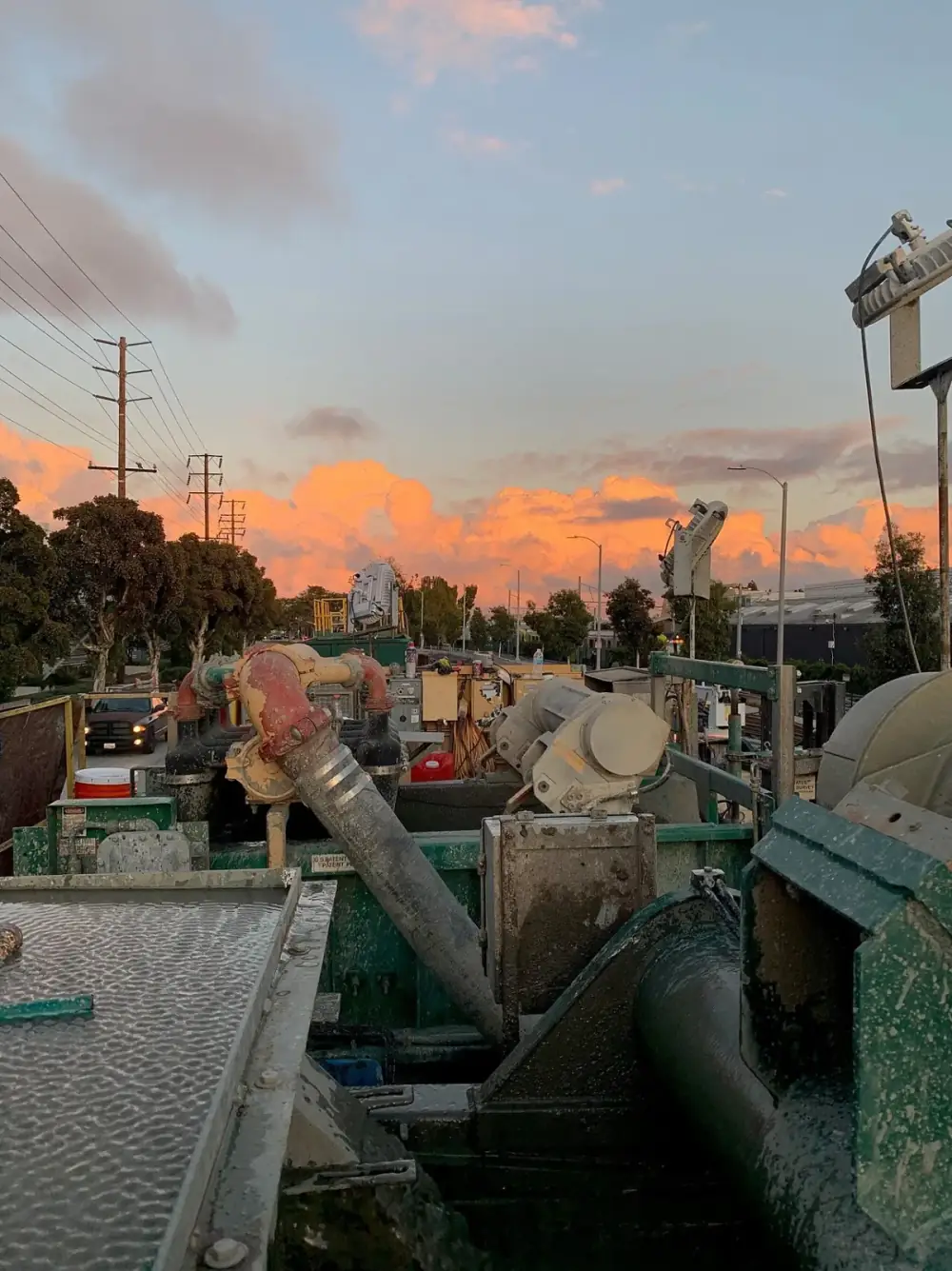
A finished well is four systems, and the price differences between contractors usually sit in parts two and three, which are the parts nobody can see afterwards.
Casing
Steel or PVC pipe run from surface down, holding the hole open and keeping shallow water out. Diameter is chosen for the pump that will go in it, which is why the pump conversation belongs at the quote stage and not after the hole is finished. Material choice matters more in brackish ground, where corrosion shortens the life of the casing well before the borehole runs out.
Screen and gravel filter pack
The slotted screen is set only across the interval that produces, and gravel pack is placed in the annulus around it. The pack is what keeps formation sand out of your pump. If a well produces sand from the first month, the filter pack or the screen slot size is usually the reason, and it is far cheaper to get right during drilling than to correct later through well rehabilitation.
The annular seal
Cement or bentonite grout filling the space between casing and borehole wall, placed from seal depth to surface. This is the part of the job that protects your own drinking water from your own septic system, your neighbor's irrigation return flow, and whatever runs down the arroyo in a summer storm. It is invisible, it is skippable, and skipping it is the difference between a cheap bid and a good well.
Pump, tank and controls
A submersible pump on drop pipe and wire, a pitless adapter through the casing below frost depth, a pressure tank and a pressure switch. The pump is sized against the tested yield and drawdown from development, not from the well depth alone. Texas pump replacement typically runs $1,200 to $3,500 and a complete pump system $2,500 to $6,000 installed, which gives a sense of how much of a new well budget is equipment rather than drilling.
How we drill and complete a well in El Paso
Eight steps. The two that determine whether the well is any good over twenty years are steps five and six, and neither shows up in a photo of a finished wellhead.
- 1Site visit, access check and setback measurement
We find where a rig can set up and reach, and measure the 50 foot separation from the septic tank and drain field required by 30 TAC Chapter 285. On smaller valley lots this step decides whether a well is possible at all, and it costs nothing to establish before you commit.
- 2Pull the filed well reports near your address
Every legal well in Texas leaves a State of Texas Well Report. We read the ones near your property for completed depth, static water level, tested yield and logged formations, so the target depth on your quote reflects what the ground has actually given up nearby.
- 3Written scope with depth, casing and a per-foot rate
The scope names the expected depth range, casing material and diameter, screen interval, development method, the per-foot rate, and what happens to the price if the hole has to go deeper. Without those figures two quotes cannot be compared, however similar the totals look.
- 4Drill the borehole
Rotary or air rotary depending on formation. Valley work is generally shallow drilling through alluvial sand and gravel. Mesa work is several hundred feet of bolson basin fill, silt, sand, gravel and clay, which takes longer and is the reason mesa wells cost multiples of valley wells at the same diameter.
- 5Set casing, screen and gravel filter pack
Casing holds the hole open and keeps shallow contamination out. The slotted screen is set across the interval that actually produces, and gravel pack is placed around it to keep formation sand out of the pump. Screen placement is also how we stay above the brackish water that sits lower in both bolsons.
- 6Grout the annular seal
The space between casing and borehole wall is sealed with cement or bentonite from seal depth to surface. Nobody ever sees this and it is the single most important step for protecting your own water, because without it septic effluent, irrigation return flow and surface runoff can track straight down the outside of the casing.
- 7Develop the well and test the yield
The well is surged and pumped until it produces clear water, then tested for yield and drawdown. Those two numbers size the pump. A pump chosen from the borehole depth alone, without a drawdown test, is the most common reason a new well burns out a pump inside a few years.
- 8Set the pump, sample the water, file the report
Submersible pump, drop pipe, wire, pitless adapter, pressure tank and controls, then a water sample for total dissolved solids and bacteria. The State of Texas Well Report is filed through the Texas Well Report Submission and Retrieval System inside the 60 day deadline in 16 TAC section 76.70, and you get a copy for the property file.
Permits, licensing and paperwork
There is no groundwater district permit for a domestic well in El Paso County, because there is no district. What remains is state law, and it is short. The driller must hold a TDLR water well driller license and the pump installer a pump installer license, unless you are the landowner working on your own property for your own use. A State of Texas Well Report must be filed within 60 days of completion. The well must sit 50 feet or more from any septic tank and drain field. And the landowner carries the duty, and the liability, to plug the well when it goes out of service.
Worth knowing but not a permit: part of El Paso County is designated by the TCEQ as a Priority Groundwater Management Area, which flags critical groundwater problems in the region. It does not change what you have to file today. The El Paso County well permit guide walks through each requirement with the source documents linked.
Water quality is the local risk, not water quantity
Salinity, not scarcity, is the thing that surprises new well owners here. The upper Hueco Bolson carries fresh to slightly saline water, around 1,000 to 3,000 mg per liter of total dissolved solids according to El Paso Water, while the Texas Water Development Board puts the fresher upper part at under 500 to over 1,500 mg per liter. Mesilla Bolson water ranges from fresh to saline and gets saltier toward the south and in shallower zones, and water level declines have pushed salinity up in both basins over time.
The regional answer to that is visible in public infrastructure: El Paso treats brackish Hueco Bolson groundwater at utility scale rather than abandoning it. On a residential scale the answer is smaller and cheaper, but it starts the same way, with a total dissolved solids test before anybody sells you a treatment system.
When drilling a new well is the wrong answer
If you already have a well and it has stopped performing, drilling a replacement is usually the most expensive option on the table and often not the right one. A well producing less than it used to, or producing sand, frequently has a plugged screen, a corroded casing section or a pump set at the wrong depth, and all three are cheaper to address than a new borehole.
The order that saves money is: test the water, inspect the well, then decide. An inspection that measures flow, drawdown and static level tells you whether the aquifer changed or the hardware did, and those are completely different problems with completely different bills.
Why so much of El Paso County is on private water
El Paso Water serves the city, and in a normal year draws about half of the municipal supply from the same aquifer private wells use. Nearly 90 percent of all water pumped from the Hueco and Mesilla bolsons in Texas goes to public supply. The private-well demand sits in the unincorporated ring: the valley communities along the Rio Grande and the mesa communities to the east, where utility service either ends or never arrived.
That is the pattern behind the well report data. Two ZIP codes on the west-side river corridor carry 178 of the county's 517 filed reports between them, and the deep-well cluster sits on the mesa. It is also why the honest first question on any quote here is which of those two worlds your property is in. Start at the service area page or send the address through the contact form and we will tell you what the neighbors hit.