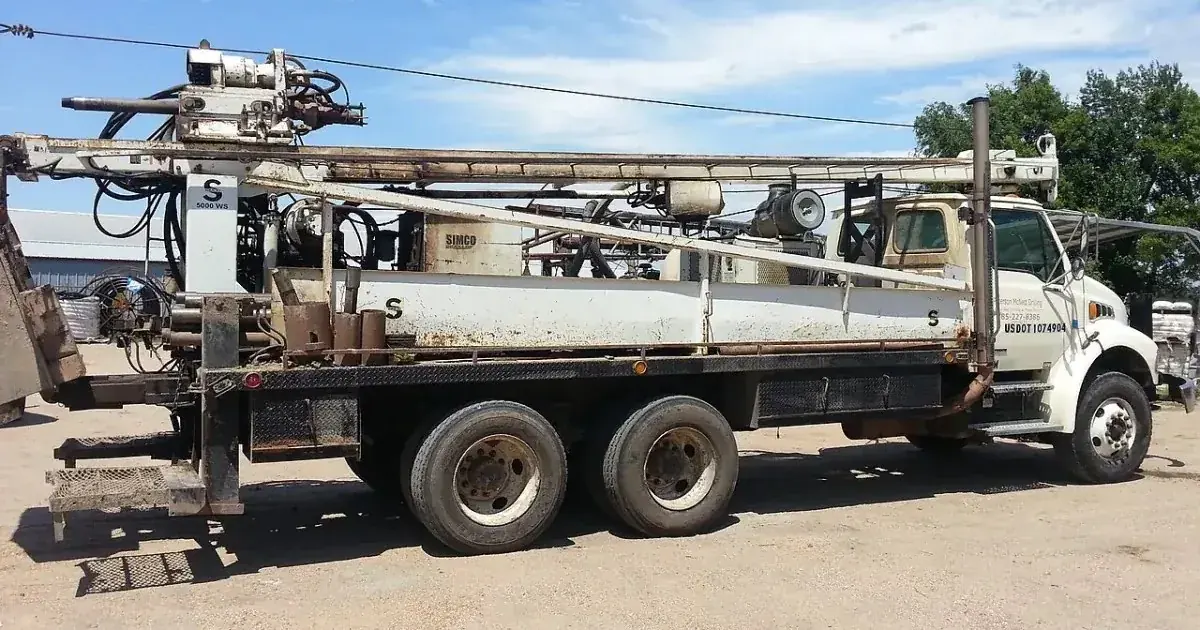
Water Well Drilling in El Paso, TX
New domestic wells, pump and pressure tank work, water testing and well plugging across El Paso County. Filed state well reports put the median well here at 160 feet, not the 350 feet the national cost sites quote, so you get a target depth taken from real reports near your lot and a written price before anything turns.
- New water well drilling
- Well pump repair and installation
- Well water testing and treatment
- Well plugging and abandonment
Water Well Services in El Paso, TX
Four jobs cover almost every call that comes in from El Paso County: drilling a new well, keeping the pump and tank running, dealing with what the water is carrying, and closing an old well properly. Each one has its own page with the local numbers behind it, because a well in the Upper Valley and a well out on the Hueco mesa are not the same job even when the invoice headings match.
Why Two Wells in El Paso County Can Cost Double Each Other
The single biggest driver of what a well costs here is whether your lot sits in the Rio Grande valley or up on the mesa. El Paso Water describes two aquifers meeting at the Franklin Mountains: the Hueco Bolson to the east, holding roughly 9,000 feet of basin fill, and the Mesilla Bolson to the west with about 2,000 feet. Both extend into New Mexico and Mexico, and in a normal year the aquifer supplies around half of El Paso's municipal water.
The filed well reports show what that means at the property level. Across 517 State of Texas Well Reports for El Paso County, the median depth is 160 feet and the middle of the distribution sits between 80 and 570 feet, but 124 wells are deeper than 600 feet. The two ZIP codes with the most filed wells, 79922 and 79932, are both on the west side along the Upper Valley and Rio Grande corridor.
Reading those two facts together points to a valley and mesa split: shallow wells into river alluvium along the Rio Grande, and deeper wells into bolson fill out on the mesas at Horizon City and Montana Vista. That split is our interpretation of the distribution rather than a figure any agency publishes, so we treat it as a starting hypothesis and confirm it against the filed reports nearest your parcel before quoting a depth.
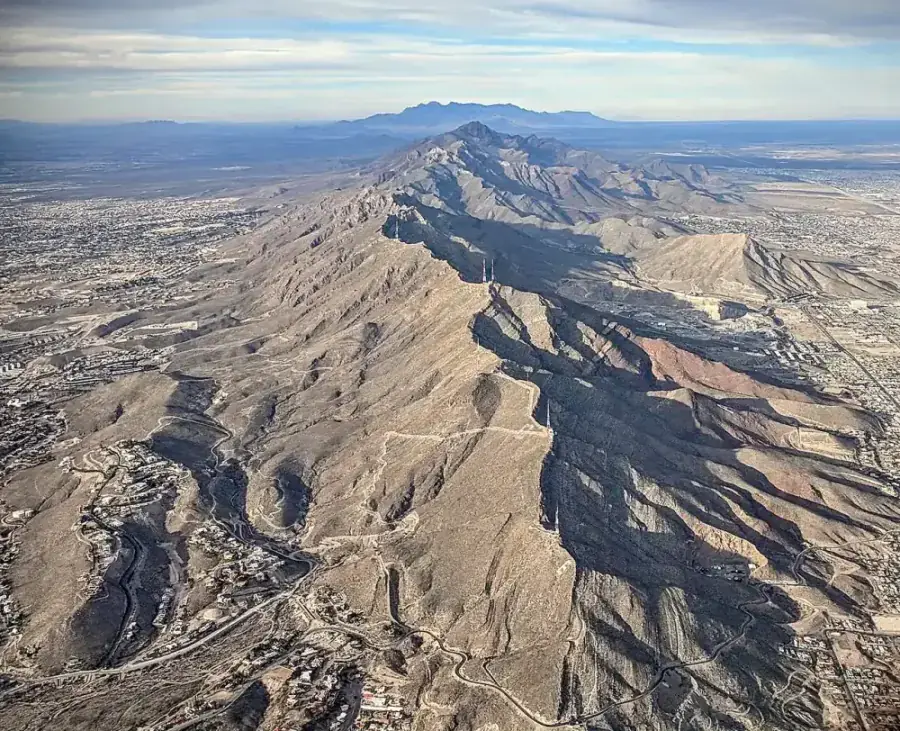
The Franklin Mountains divide El Paso. Wells east of the range draw the Hueco Bolson, wells west of it draw the Mesilla Bolson.
What a Water Well Costs in El Paso, TX
Drilling in El Paso runs $28 to $64 per foot, above the $25 to $58 per foot Texas average, and a complete system at the county median depth lands between about $10,800 and $18,000. Published cost data puts the average complete Texas water well at around $8,550 and flags the Trans-Pecos as the most expensive region in the state, reaching roughly $40,000 on the deepest jobs. El Paso runs high on the per-foot rate because mesa formations are harder to cut and brackish intervals have to be cased off cleanly.
| Depth | Drilling and casing | Complete system |
|---|---|---|
| 100 ft | $2,800 to $6,400 | $7,600 to $11,200 |
| 150 ft | $4,200 to $9,600 | $9,400 to $14,800 |
| 200 ft | $5,600 to $12,800 | $11,200 to $18,400 |
| 300 ft | $8,400 to $19,200 | $14,800 to $25,600 |
| 400 ft | $11,200 to $25,600 | $18,400 to $32,800 |
| 500 ft | $14,000 to $32,000 | $22,000 to $40,000 |
Complete system means casing, pump, pressure tank, electrical, permits and reporting, and water testing. Ranges published by WellDrillingCosts for El Paso TX. Full sourcing and the county median figures are on the cost guide.
Pump and tank work is quoted after an inspection rather than off a rate card, because what gets replaced depends on what failed. A pump that will not build pressure, a waterlogged tank and a failed control box are three different invoices. Read the full El Paso well drilling cost guide →
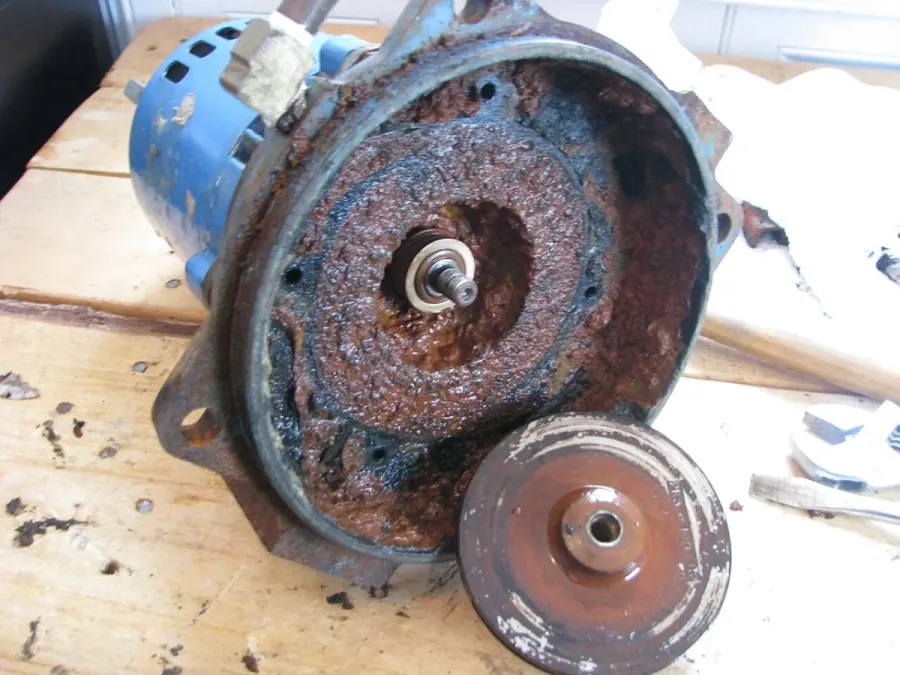
A pump housing opened up during repair. Scale and corrosion on the impeller is the usual reason pressure falls away long before the pump stops completely.
Signs You Need a Well Contractor in El Paso
Most well calls start weeks after the first symptom. Pressure that sags, grit in the aerators and a pump that cycles are all early warnings, and catching them early is the difference between a service call and pulling several hundred feet of drop pipe.
- Pressure drops off when two taps run at once, or the pump short cycles on and off
- Sand or grit in the aerators, the toilet tanks or the bottom of the water heater
- Water level in the well has dropped and the pump is breaking suction in the afternoons
- Scale on fixtures, white crusting on evaporative cooler pads, or a salty taste that got worse
- A pump that runs but does not build pressure, or a pressure tank that has waterlogged
- An old well on the property that is uncapped, unused, or that nobody has records for
- You are buying an acreage lot outside the water utility service area and need a supply before you build
How a Water Well Gets Drilled in El Paso, TX
A domestic well here moves through seven stages, and two of them happen before the rig arrives. Checking the 50 foot septic setback and pulling the filed well reports for nearby properties is what keeps the quote honest, because the county average depth is a poor predictor for any single lot.
- 1Site visit and well report research
We walk the property, find where the rig can physically reach, and check the setbacks: 50 feet from the septic tank and drain field, clear of the leach lines and the property line. Then we pull the filed State of Texas Well Reports for nearby properties so the target depth is based on what drillers actually logged near you, not a county average.
- 2Written scope and quote
You get a target depth range, casing diameter and material, the completion method, the pump size the house needs, and a price. Household demand is normally 5 to 10 gallons per minute, so the quote is written around that rather than around the headline yields on municipal wells.
- 3Drilling and formation logging
The rig sets up and drills, logging each formation change as it goes. In the valley that means alluvial sand and gravel; up on the mesa it means bolson fill with cemented layers that slow progress. The log is what determines the final depth and where the screen goes.
- 4Casing, screen and sealing
Casing goes in and the annulus is sealed so surface water and any brackish zone above the production interval are shut out. On the mesa this step is the one that decides whether you get good water or salty water, because the fresh zone often sits above deeper saline water.
- 5Development and yield testing
The well is developed to pull fines out of the screen, then pumped and timed to establish a sustainable yield and a static water level. Median static level across filed El Paso County reports is 15 feet below the surface, but the middle half of wells spread from 9 to 175 feet, so this gets measured rather than assumed.
- 6Pump, pressure tank and water test
A licensed pump installer sets the submersible pump, pitless adapter, pressure tank and controls, and the water is sampled. Total dissolved solids matter here because the Hueco and Mesilla Bolsons both run fresh to saline, and the TDS number is what decides whether you need treatment and which kind.
- 7State Well Report filed
The driller files the State of Texas Well Report through the state submission system within 60 days of completion, as required by Title 16 of the Texas Administrative Code, Section 76.70. You get a copy for your records, and it becomes the document that answers every future question about your well.
A Well Crew That Works El Paso County, Not the Whole State
Plenty of the drilling outfits that show up in an El Paso search are based hours away or do pier and foundation work rather than water wells. That matters, because the things that decide whether a domestic well here is any good are local: which bolson you are over, how deep the fresh zone runs before the water turns saline, and where the caliche and cemented gravel sit.
We work El Paso County and the western edge of Hudspeth County: the Upper Valley and Canutillo, the Lower Valley through Socorro, San Elizario, Clint and Fabens, the mesa at Horizon City and Montana Vista, and north to Anthony at the New Mexico line. Every quote names the target depth range and the completion method, and every job gets its State of Texas Well Report filed inside the 60 day deadline the state allows.
More about how we work →
Well Drilling Service Area Across El Paso County
Private wells in El Paso County cluster outside the utility service areas: the Upper Valley and Canutillo on the west, the Lower Valley farming communities downstream, and the mesa subdivisions east of the Franklins. Each of those has its own page.
El Paso Well Owner Guides
Three guides covering the questions that decide a well project here: what it costs, what the state requires when there is no groundwater district, and which aquifer sits under your lot.
Water Well Drilling El Paso TX: Frequently Asked Questions
How much does it cost to drill a well in Texas?
Drilling runs about $25 to $58 per foot statewide, and the average complete Texas water well project comes to roughly $8,550, according to the cost data published by WellDrillingCosts. El Paso sits above that statewide average at $28 to $64 per foot, because the mesa formations are harder and brackish zones have to be cased off. At the El Paso County median depth of roughly 180 feet for wells drilled since 2016, a complete system with casing, pump, pressure tank, electrical and water testing works out to about $10,800 to $18,000.
How much does it cost to drill a 1,000 foot well?
At El Paso rates of $28 to $64 per foot, 1,000 feet of drilling alone is $28,000 to $64,000 before casing, pump, tank and electrical are added. That is arithmetic from the per-foot range, not a quote, and very few homes here need that depth. Of 517 State of Texas Well Reports filed in El Paso County, 124 are deeper than 600 feet, and those are mostly municipal and irrigation wells rather than houses.
How deep are water wells in El Paso County?
The median depth across 517 State of Texas Well Reports filed in El Paso County is 160 feet, rising to about 180 feet for wells drilled since 2016. The typical range is 80 to 570 feet. You will see 350 feet quoted as the El Paso norm on national cost sites, and the filed well reports do not support that: 240 of those 517 wells are shallower than 150 feet. Depth depends far more on whether your lot sits in the Rio Grande valley or up on the mesa than on any county-wide average.
Do I need a permit to drill a water well in Texas?
In El Paso County there is no groundwater conservation district, so there is no district drilling permit and no district spacing rule. The Texas Water Development Board lists El Paso and Hudspeth counties as Groundwater Management Area 5 and states plainly that no groundwater conservation districts exist inside it. The state rules still apply: the work has to be done by a driller licensed by the Texas Department of Licensing and Regulation, a State of Texas Well Report must be filed within 60 days of completion, and the well has to sit at least 50 feet from any septic tank or drain field.
What is the lifespan of a water well?
Industry sources put the working life of the well itself at roughly 20 to 50 years, with the components inside it wearing out much sooner. Groundwater association and Water Well Journal life-cycle material puts a submersible pump at about 8 to 15 years, a pressure tank at 10 to 15, and controls and switches at 10 to 20. Those are industry estimates rather than a guarantee. What usually ends a well early here is not age but a collapsed or encrusted screen, or a casing that was never sealed properly against a brackish zone.
Is El Paso well water salty?
It can be, and it depends on which aquifer and which depth the well draws from. El Paso Water describes the upper Hueco Bolson as fresh to slightly saline at under 1,000 to 3,000 mg/L of total dissolved solids, and the Texas Water Development Board puts the fresher upper part at under 500 to over 1,500 mg/L. Salinity generally increases with depth, toward the south of the county, and where water levels have dropped. Test for total dissolved solids before you size any treatment equipment, because a softener and a reverse osmosis system solve different problems and cost very different money.
More questions on depth, salinity, septic setbacks, plugging and looking up filed well reports.
See the full El Paso well drilling FAQ →Get a written quote for your El Paso well
Tell us where the property is and what you need. You get a target depth range, a completion method and a price in writing, with no obligation.
Get a Free Quote