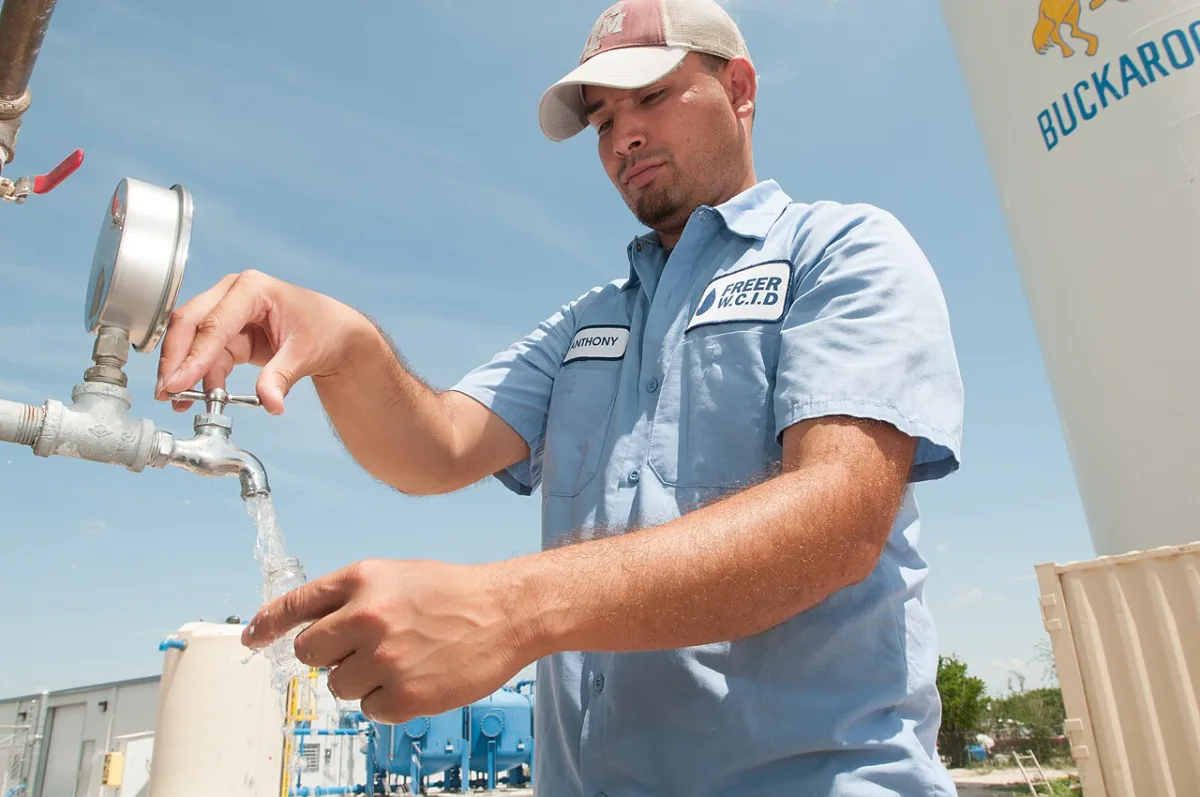
Test El Paso well water for total dissolved solids, hardness and bacteria before you buy any treatment equipment. Salinity is the defining water quality issue in this county, and it is the one problem a standard water softener will not touch. Getting a lab number first is what separates a $400 decision from a $4,000 mistake.
The reason is geology rather than anything anyone did to the water. El Paso County sits over the Hueco Bolson east of the Franklin Mountains and the Mesilla Bolson to the west, together a major Texas aquifer of about 1,370 square miles. El Paso Water describes the upper Hueco as holding fresh to slightly saline water in the range of under 1,000 to 3,000 mg per liter of total dissolved solids, while the Texas Water Development Board puts the fresher upper part at under 500 to over 1,500 mg per liter. Both basins grade saltier with depth and toward the south of the county.
What to test for on an El Paso County well
Four analytes answer almost every question a well owner here actually has. Anything beyond them is worth adding once you know what the first panel says, not before.
Total dissolved solids
This is the salinity number, and in El Paso it is the one that decides your treatment path. It tells you whether you are dealing with water that needs nothing, water that needs point of use reverse osmosis for drinking and cooking, or water that needs a whole house approach. It also predicts equipment life: higher dissolved solids mean more scale on pump impellers and more corrosion on casing, wire splices and fittings.
Hardness
Hardness is calcium and magnesium, and it is what crusts the evaporative cooler pads, scales the water heater element and leaves white film on fixtures. In a desert climate where evaporative cooling is common, hard water costs real money in cooler maintenance long before anybody thinks about the well. Hardness is a softener problem, and a softener genuinely solves it.
Bacteria
A coliform screen is a test of the well, not just the water. Bacteria in a properly constructed well usually means surface water is finding a path down, which points at the annular seal, the well cap, or a wellhead sitting too low in ground that floods. On valley properties where static water can sit within 15 feet of the surface, that path is short and the seal is the only thing closing it.
Nitrate
Worth adding on valley lots near irrigated farmland or older septic systems. Nitrate travels well in shallow alluvial groundwater and it is the analyte that matters most if anyone in the household is pregnant or bottle feeding an infant. It is not a standard concern on deep mesa wells, which is why we add it based on where the property sits rather than on every job.
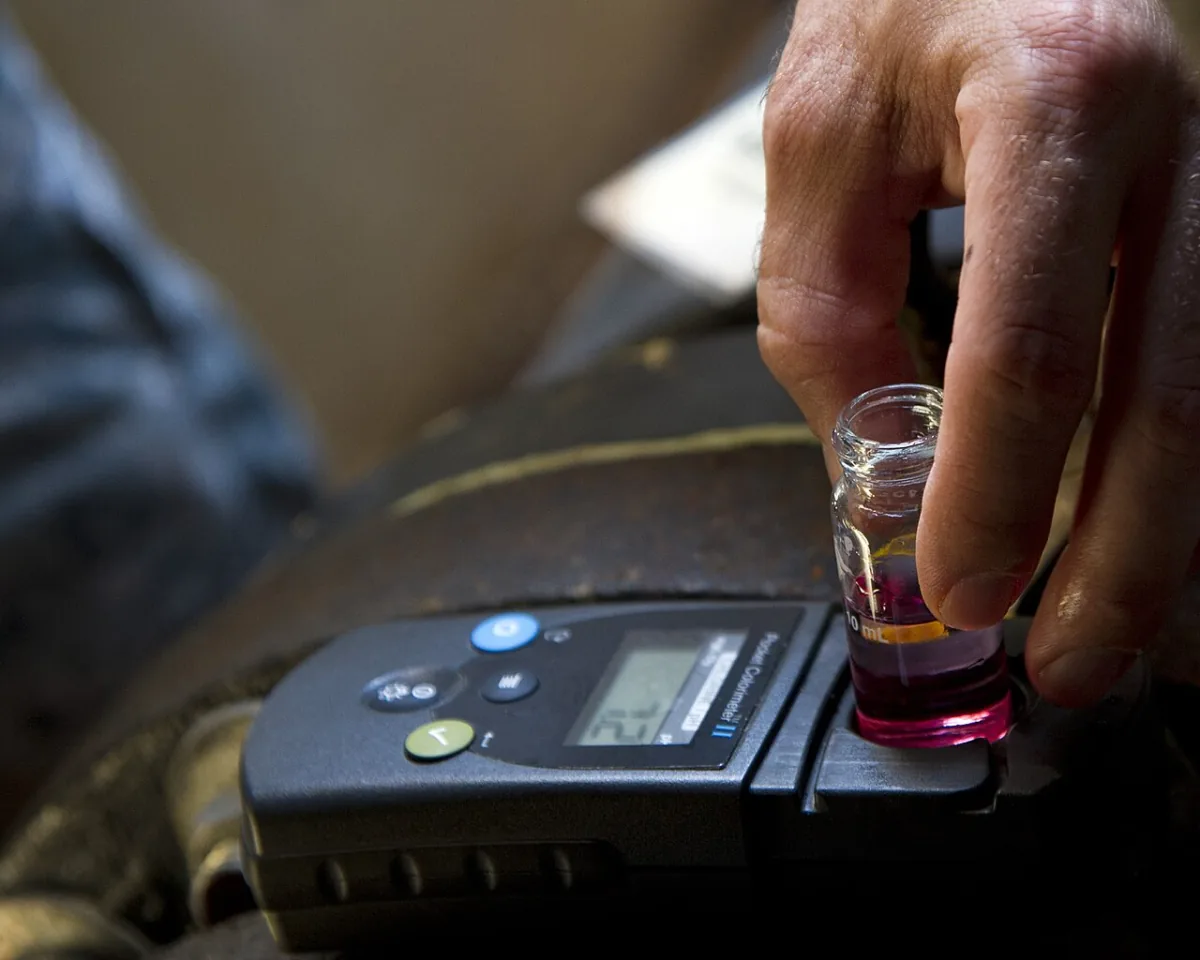
Matching treatment to the result, not to the complaint
The right equipment follows directly from the lab sheet, and the wrong equipment follows from the symptom. Salty taste and scale feel similar at the tap and have completely different solutions.
| What the lab shows | What actually fixes it | What will not |
|---|---|---|
| High total dissolved solids, salty taste | Point of use reverse osmosis for drinking and cooking, or blending if a second source exists | A water softener. It swaps hardness ions for sodium and leaves dissolved solids where they were |
| High hardness, scale on fixtures and cooler pads | Ion exchange softener sized to household draw | Reverse osmosis alone. It protects the tap but not the water heater or the cooler |
| Coliform present | Shock chlorination, then find the entry path: well cap, annular seal or wellhead elevation | Any filter. Treating the symptom leaves the opening that let it in |
| Sand or sediment in the water | Screen and gravel pack work at the well, sometimes a sediment filter as an interim | A softener, which the sand will simply destroy |
| Elevated nitrate on a valley lot | Reverse osmosis at the tap, and a look at septic setbacks and the annular seal | Boiling, which concentrates nitrate rather than removing it |
Every row starts from a laboratory result. We do not quote treatment equipment from a description of the taste.
Testing before you buy a property with a well
Test before closing, and pull the filed well report at the same time. In El Paso County nobody is obliged to hand you a water quality history with the property, and there is no groundwater conservation district holding records on your behalf. The Texas Water Development Board does publish the State of Texas Well Reports through its Groundwater Database, Water Data Interactive map and Submitted Drillers Report Database, so the completion depth, static water level, logged formations and tested yield for the well you are about to inherit are usually a free lookup.
Read the report and the lab sheet together. A well completed across both a fresh interval and a deeper saline one explains a salty result in a way no amount of treatment shopping will, and it changes what the sensible fix is. The aquifer and well depth guide walks through how to read a filed report for exactly this.
What treatment does not solve
Treatment fixes water chemistry and nothing else. If the well is producing sand, losing yield or cycling the pump, those are hardware and completion problems that filters will only mask while quietly shortening the life of everything downstream. Sand in particular destroys softener valves and pump impellers, and it comes from screen slot size or gravel pack rather than from anything a cartridge can catch economically.
The order that saves money is test, inspect, then decide. If the test says the chemistry is fine and the symptoms persist, the problem is mechanical, and pump and pressure system work is where to look next. If the well is beyond economic repair, the honest comparison is against a new well, and an old well left open afterward still has to be plugged properly.
Send the property address and the symptoms through the contact form, or check coverage on the service area page.